What Happens at a Laser Hair Removal Consultation?
Inside Beam’s free NYC consultation: hair and skin assessment, test patches, risks, pricing and realistic expectations.

Perhaps you shave in the morning and already see a shadow by the afternoon. Perhaps your neck becomes irritated every time you groom. Or perhaps you would simply like less hair to manage.
Whatever brought you here, you do not need to arrive knowing which treatment to buy. That is part of what the consultation is for.
At Beam Laser Spa in Midtown Manhattan, we require a complimentary laser hair removal consultation with test patches before starting a new laser treatment. Expect to spend approximately 30 to 40 minutes with us.
We want you to understand how laser works, whether it makes sense for your hair and skin, and what you can realistically expect. You should also have plenty of time to ask questions before deciding whether to proceed.
We start with what you would like to change
After completing your paperwork, you will meet with one of our laser specialists in a private treatment room.
We talk about the areas you are considering, your current hair removal routine, and what you hope to achieve. A cleaner neckline is different from removing an entire beard. A few coarse chin hairs call for a different discussion from fine hair spread across the cheeks.
Tell us what areas of the face or body you are primarily interested in and what a worthwhile improvement would mean in your everyday life.
We want to understand your goals and determine whether we believe we can deliver results that make the process and investment worthwhile for you.
Explore treatment details for underarm laser hair removal, Brazilian laser hair removal, and full leg laser hair removal.
We explain how laser hair removal works
Our consultation includes a detailed explanation of the entire process, because the recommendations make much more sense when you understand the reasoning behind them.
Laser hair removal targets melanin, the pigment in the hair. The absorbed light becomes heat, which damages structures within the follicle responsible for hair growth.
This is why dark, coarse hair generally responds best: it provides a stronger target. Fine hair or hair with very little pigment requires a different conversation.
It also explains an important instruction during your treatment series: you may shave or trim regrowth, but you should not wax, pluck, thread, or use an epilator. Those methods pull hair out from the root, removing the pigmented hair we need available for treatment.
If you have recently waxed or plucked, tell us when booking. We can advise you on when an assessment or treatment would make sense.
We would much rather explain the “why” than hand you a list of rules to memorize.
We look at your hair, skin, and treatment history
We assess the hair’s color, thickness, and distribution, along with your skin tone and current skin condition.
If you have had laser elsewhere, we want to hear about it. What improved? What did not? Did you experience any reactions or changes in pigmentation? Treatment records can be helpful, if you have them, but are not absolutely necessary.
We also review relevant health and skin history, prescriptions, over-the-counter medications, supplements, and topical products used on the proposed treatment areas. These details help us assess whether anything could affect your skin’s response or whether treatment should be postponed.
Please mention recent sun exposure, tanning beds, spray tans, and self-tanner, too.
You do not have to decide for yourself whether something is relevant. Tell us, and we can discuss it.
We discuss the laser we use and why
Beam Laser Spa uses the Candela GentleMax Pro Plus, which offers Alexandrite and Nd YAG wavelengths. This allows us to safely and effectively treat clients of all skin tones, including highly pigmented clients, with Fitzpatrick Skin Type 6.
We explain how our treatment approach relates to your particular hair and skin. Our decisions draw on manufacturer and scientific guidelines, our training, and our years of experience performing laser hair removal.
You should understand why we recommend an approach without feeling that you need to become a laser specialist yourself.
We talk openly about risks and safety
We explain the temporary redness, swelling around the follicles, and discomfort that can occur after treatment. We also discuss potential complications, including burns and blistering, lighter or darker pigmentation, and less common complications such as scarring.
Pigment changes are often temporary, but they can sometimes persist.
Another topic is paradoxical hypertrichosis, an uncommon reaction in which hair growth increases rather than decreases. This deserves particular consideration when assessing fine facial, neck or shoulders and back hair.
Before performing test patches, we explain the protective eyewear you will wear. Your goggles stay on throughout the procedure, even when we are treating an area far from your face. Please ask your specialist before removing them.
We take precautions to reduce risk, but no responsible provider can promise that a reaction will never happen. We believe you should understand the possibilities before deciding to proceed.
How many laser hair removal sessions will you need?
This is one of the questions we hear most often, and it deserves an honest answer.
We can discuss typical treatment ranges and what we would reasonably expect for the areas you are considering. We cannot predict your exact final session count before seeing how your hair responds over time.
The laser and the person operating it matter. So do your hair’s thickness and color, treatment area, growth cycles, hormonal influences, and individual biology.
Even different areas on the same person can respond differently.
At Beam, we speak in averages, not absolutes. We cannot guarantee something that depends partly on biology, and we would rather explain that clearly and transparently at the beginning.
A six-session package describes what you are purchasing. It does not mean your hair is guaranteed to be finished responding after six visits.
We also discuss maintenance. Laser can provide substantial, lasting hair reduction, but that does not mean every person will remain completely hair-free without future treatment.
Sometimes, we recommend another approach
We may discourage laser on an area if we do not believe the likely improvement justifies your time and expense.
For certain fine or lightly pigmented hairs, we may suggest consulting an electrolysis specialist instead. Electrolysis does not depend on hair pigment in the same way laser does.
Being transparent includes telling you when we think another option may serve you better.
For a closer look at suitability, read our guide to laser hair removal candidacy.
What happens during a laser test patch?
After assessing suitability and discussing preparation and aftercare, we perform small test patches on appropriate areas you would like assessed. If you are considering several areas, we can discuss testing those areas during your consultation.
A test patch gives you a firsthand sense of the treatment sensation and helps us assess how the tested skin responds.
We explain what to watch for afterward, how to care for the area, and when a full treatment may be appropriate. Some reactions develop after you leave, so how the skin looks immediately afterward is only part of the assessment.
A successful test patch is useful information. It cannot predict your final results or guarantee that every future session will produce the same skin response.
That is why we ask about changes in medications, skincare, and sun exposure at subsequent visits. Your first consultation gives us a starting point; we still need to understand what may have changed every time you come in for a treatment.
Why are laser treatments spaced apart?
Hair grows in cycles, and not every hair is equally responsive to laser at the same time. Appropriate spacing helps us reach different groups of hairs as they become available for treatment.
We discuss an initial schedule based on the area being treated, then reassess as your hair responds. Facial and body hair may require different intervals, and those intervals may change over time.
If your next appointment is approaching and you have very little regrowth, contact us. We would rather discuss whether the timing still makes sense than have you come in simply because a date is on the calendar.
We explain preparation, aftercare, and cost
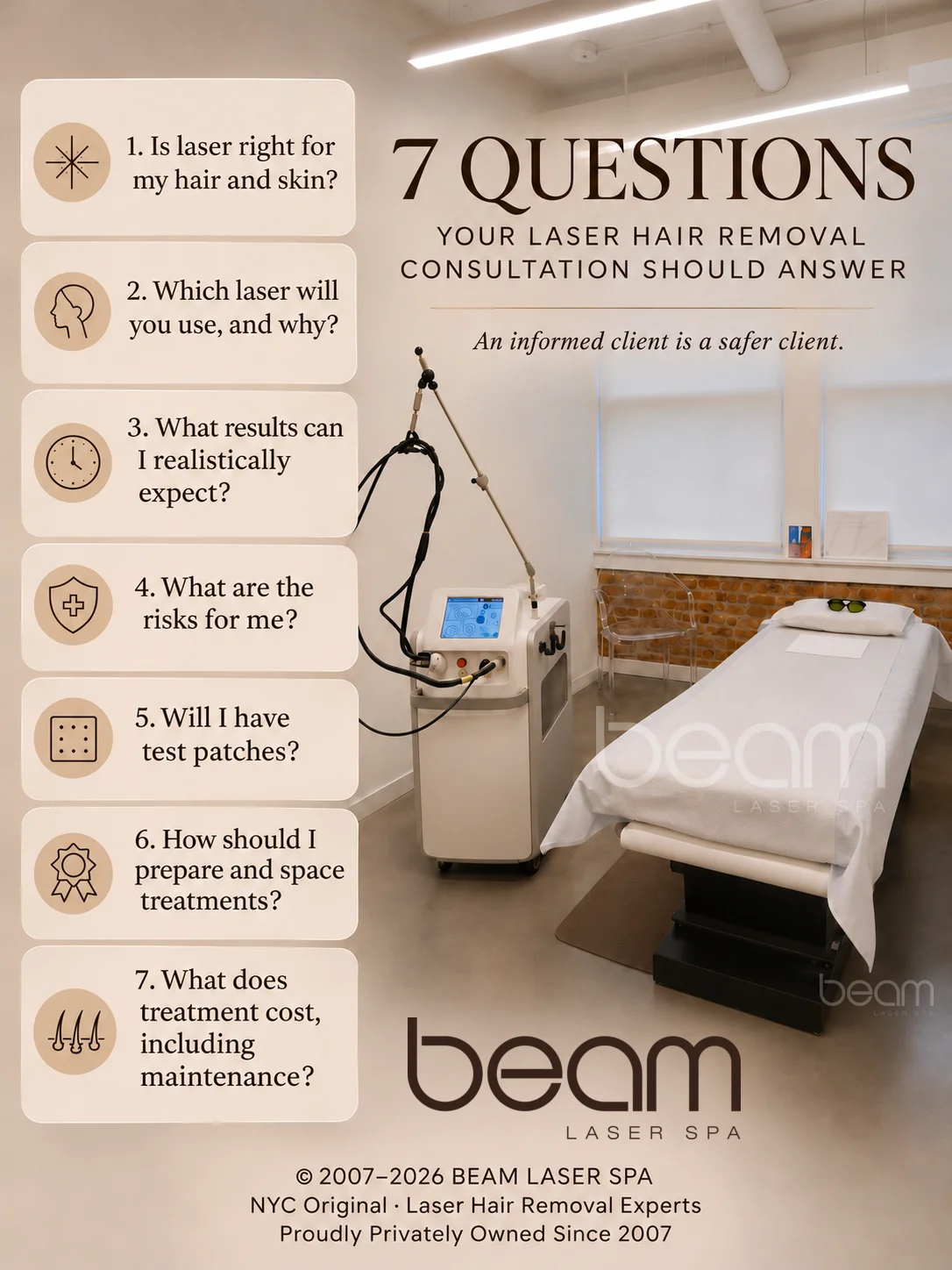
Before you leave, we discuss how to prepare for treatment, what reactions you might notice afterward, and how to care for your skin.
We also explain how treatment areas are defined, pricing, package options, purchase terms, and how maintenance may fit into your longer-term plan.
Ask anything you need to ask. If something needs explaining twice, we are happy to explain it twice.
Our laser hair removal preparation guide is a useful reference once treatment is scheduled.
Should you shave before your consultation?
Check with us before shaving the areas you want assessed. Seeing the hair’s natural color, thickness, and distribution helps us evaluate it, while any skin selected for test patches needs appropriate preparation.
A consultation and a full treatment appointment serve different purposes, so do not assume their preparation instructions are identical.
When booking, let us know which areas you would like to discuss and how you currently remove the hair. We can guide you from there.
You do not have to decide on the spot
Our consultation is complimentary, and there is no obligation to purchase.
We realize that choosing where to have laser hair removal is an important decision. You are trusting someone with your skin, your time, and your money.
We want Beam Laser Spa to feel like a good fit for you: a place where you receive thoughtful attention, clear explanations, and treatment guided by experience.
You should leave understanding your options and feeling comfortable with your next step—even if that next step is taking some time to think.
Book a complimentary laser hair removal consultation at Beam Laser Spa in Midtown Manhattan.

About the author — Andréa Young
B.S. in Cell & Molecular Biology · MBA
Co-owner, Beam Laser Spa NYC
Laser Hair Removal Specialist Since 2007
Andréa Young combines a background in cell and molecular biology with hands-on laser hair removal experience at Beam Laser Spa, which she co-founded with her sister Liza Young in Midtown Manhattan in 2007 as a privately owned, boutique business.
She collaborates from time to time with Candela’s engineering, product development, and quality assurance teams, including testing products before launch.
Andréa and Beam Laser Spa have been quoted for their laser hair removal expertise in national publications including Vogue, Allure, New York Magazine, and the New York Post, among others.
© Beam Laser Spa. The written content, graphics, illustrations, logos and original images featured on this website are protected intellectual property and may not be reproduced without permission.